
The Worcester County Poetry Association is now accepting applications for the 2025 Dan Lewis Fellowship to provide an aspiring Worcester County poet the means to fulfill a need in that poet’s development that might otherwise go unmet. The 2025 Fellowship award will be $2,500. The application deadline is November 1, 2024.
The online application form and details can be found at this link: The Dan Lewis Fellowship – Worcester County Poetry Association.
Reposting on our site a powerful interview with the esteemed Martin Espada.
IN CONVERSATION WITH MARTÍN ESPADA
Martín Espada is an acclaimed poet, editor, essayist, and translator. He is also one of four individuals being honored this year with the Governor’s Award in the Humanities. Espada’s 2021 book of poetry, Floaters, won the National Book Award for Poetry. We recently sat down with Espada at his home in Shelburne Falls to ask him about his craft, how the humanities intersect with his work, and how our present moment calls for “poems of love.”
This interview has been edited and condensed.
Martín, thank you for sitting down with us. Why don’t we start at the beginning. When did you first hear about the work that Mass Humanities was doing in Massachusetts?
I remember Mass Humanities from the eighties. I attended Northeastern University Law School in Boston and graduated from there in 1985. I went to work for an organization called META, Multicultural Education Training and Advocacy, a nonprofit, public interest law firm specializing in the rights of linguistic and cultural minorities. Camilo Pérez-Bustillo was my fellow attorney and close friend at META.
We decided to stage several poetry conferences and festivals geared towards a community nobody was serving—the Latino community. Camilo discovered the existence of David Tebaldi at Mass Humanities. And David Tebaldi came through big time.
For the first time, we had a budget. David Tebaldi was the first person with any state agency who recognized what we were trying to do. And we did it. Then we went back to the well for more money. We began our “cultural advocacy” with a focus on Puerto Rican literature and political struggle, then expanded to the Latino community and communities of color in Greater Boston.
When I saw that this award came from Mass Humanities, what clicked was the memory of David Tebaldi and those grants he gave us to do our work in the eighties.
And you were writing during this time as well.
My life as a poet and my life as a lawyer weaved in and out. I wrote my first poem when I was fifteen, stopped writing, picked it up again, went to college, and had the canon aimed at me. That was the end of my literary education.
The wise old men in my life, such as my father, Frank Espada, a community organizer and documentary photographer, and my professor Herbert Hill at the University of Wisconsin, where I got my undergraduate degree in history, said, “You’ve got to go to law school. You’ve got to be a lawyer. Poetry is nice, but what are you going to do with it?”
I was the first one in my family to go to college. We didn’t know there were alternatives. My mother once pulled me aside and asked, “What’s a graduate student? I thought once you graduate, you’re not a student anymore.” We had never heard of an MFA. Therefore, I went to law school. I made the social and political commitment I wanted to make to my community by being a lawyer.
I never gave up on the poetry. I published my first book right before I went to law school and my second book right after I got out of law school, because you do nothing when you’re in law school but law school.
I came to lead a double life. Eventually, the Boston media picked up on it: first The Tab, then The Globe. People were astonished that a poet-lawyer could possibly exist: My god! A poet-lawyer! It’s like a creature out of Greek mythology, with the body of a lawyer and the head of a poet. One of those identities would have to absorb the other one.
From META, I moved to Su Cliníca Legal, a legal services program for low-income, Spanish-speaking tenants in Chelsea, across the Tobin Bridge from Boston: eviction defense, no-heat cases, rats and roaches, crazy landlords.
Legal services money is soft money, like any other social services, subject to cutbacks. The Reagan administration despised the federal Legal Services Corporation, where we got much of our funding, so there was a constant battle in Congress. We found other sources, but eventually, our budget was slashed. My position was consolidated with another lawyer’s position.
I could have bumped him because I had seniority, but Nelson Azócar was a friend of mine who’d come to this country from Chile after he talked his way out of being shot by a firing squad. That’s the gift of gab. Anybody who can do that should be a lawyer. I started looking. I wanted the life of a poet, whatever that meant. I ended up teaching at UMass Amherst in fall 1993.
UMass was looking for somebody who had one book. I had four. I made the transition into teaching there in 1993.
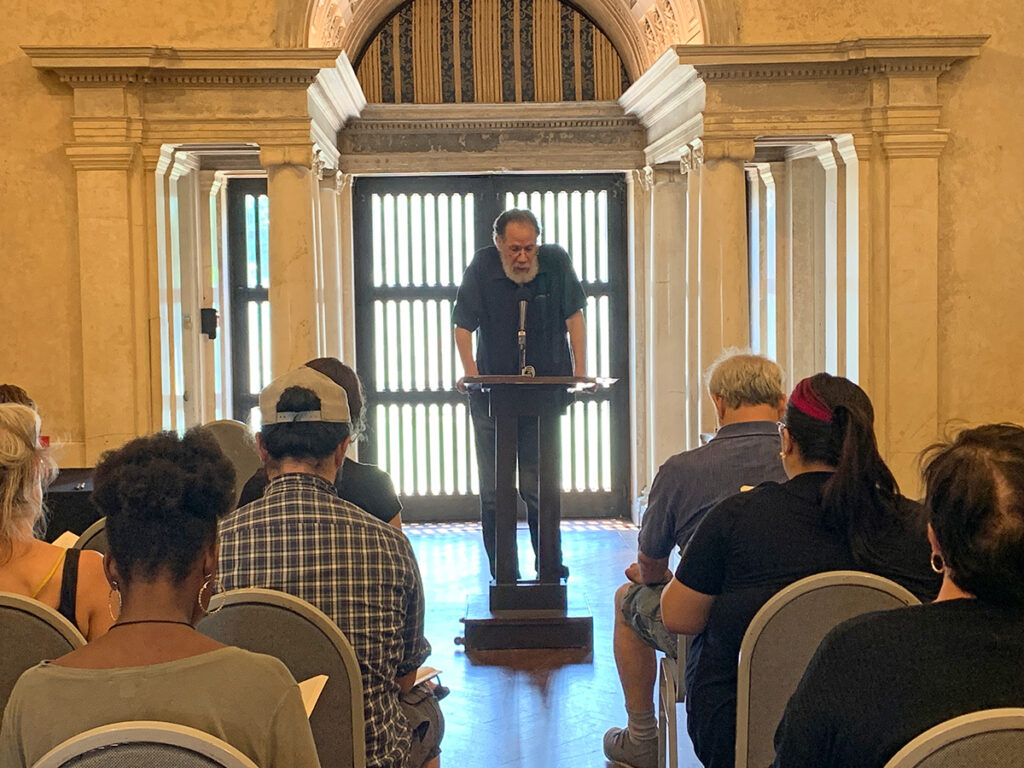
How do you see the public humanities intersecting with your work, both as an educator and poet?
Let’s take a shining example: the Clemente Course in the Humanities. I knew the guy who started it in 1995: the writer Earl Shorris. He was writing about my work in The New York Times Book Review back in the eighties. I wrote him a thank you note. That’s how we met.
I remember when he came up with the idea. And strangely enough, it eventually circled all the way back to me. I read my poems for the Clemente Course in Worcester through James Cocola and the Clemente Course in Brockton through Corey Dolgon. Corey and I tried to make it happen in person, but we ended up doing it on Zoom twice during the COVID era. This was more than a matter of serving the Brockton community—this was a matter of serving that community during the pandemic.
I’m still impressed with the vision of the Clemente Course, still impressed with the students. I’m deeply gratified when I’m able to connect in that way. Poetry should go where it’s least expected. Poetry should go where it allegedly does not belong. Poetry should go to a so-called “non-traditional” audience which is, in fact, the most traditional audience of all. Over and over, I’ve seen it work. The Clemente Course is an excellent example, but you need a big soul like Corey Dolgon to build that bridge between people.
On your website, the description for your book Floaters suggests “Espada knows that times of hate call for poems of love.” Can you speak a little more about this notion?
When I say “times of hate call for poems of love,” I’m thinking of “Floaters,” the title poem of my last book, about two Salvadoran migrants who came to be known simply as “Óscar and Valeria,” father and daughter, who drowned crossing the Río Grande. A photograph of their bodies went viral, sparking outrage, sparking grief and also sparking “trutherism.” A post in the “I’m 10-15” Border Patrol Facebook group charged that the photograph was faked. Between the photograph and this Facebook page expressing the racist bile of certain members of the Border Patrol, I had to respond. That’s how the poem came about.
“Floaters,” by the way, is a term used by certain members of the Border Patrol to describe those who drown crossing over. The hate is apparent.
When I say “times of hate,” it should be obvious we’re surrounded by hate. What do I mean, then, that you respond with poems of love? The first part is to perceive a poem like “Floaters” as a love poem that is motivated by a sense of compassion and a sense of connection that we associate with love, not romantic love, but the love we may share for our fellow human beings.
I also mean it on a more literal level, too. Times like this call for love in any iteration. There are also love poems in that book.
What is the role of that process of finding love or connection in this landscape?
I believe that poetry humanizes, that poetry can provide the kind of intimate human details so often missing when we talk about political or social issues. No matter where we are on the spectrum politically, it’s often reduced to abstraction, reduced to statistics, reduced to categories. Poetry, instead, insists upon the image, all five senses on paper. We’re insisting on giving history eyes, ears, nose, mouth, voice, insisting on looking into the hands and saying, “this, too, is human.” And telling the stories.
I am a narrative poet. This is my vehicle, my mechanism for telling stories. But I tell certain kinds of stories. That’s my effort to humanize the dehumanized. Recognizing that, I’m realistic. I’m up against this tremendous machine of dehumanization that works tirelessly into the night.
Why narrative poetry?
I work from an aesthetic of clarity. I intend to communicate. It may not look like some of the poetry you’ve seen before, poetry you gave up on. Believe me, I gave up on the same poetry. That’s one of the reasons I landed in law school. But I intend to communicate. There are enough barriers that I need to leap, whether they are cultural, linguistic, political, social, historical. I don’t need to be coy about it, or “too clever by half,” as the saying goes. I want to speak in such a way that I’m understood.
Martín, thank you for your time, and congratulations on receiving the Governor’s Award in the Humanities this year.
Announcing the 2024 WCPA Rain Poets
FOR IMMEDIATE RELEASE
WORCESTER,
Massachusetts
PO Box 804, Worcester, MA
01613
worcestercountypoetry.org
wcpaboard@yahoo.com
The Worcester County Poetry Association is pleased to announce the 2024 Rain Poets and their poems! This year’s project has expanded from our typical thirteen to include an additional twelve poems written by school-aged poets in Worcester County. A team of volunteers will paint these poems at bus stops around Worcester and at the schools of the winning student poets using Rainworks’ hydrophobic paint and stencils as large as 18 square feet. The poems will be visible to pedestrians in Worcester during inclement weather throughout the summer. We will prepare our stencils and paint over the last weekend of August, with a rain date of September 13th-15th.
2024 Rain Poets, in no particular order
Lea Bisceglia with “A Walk in the Woo”
Laura Solis-Matthew with “[tripping over cracks]”
JE. rome with “Dear Worcester,”
Lori Cornelius with “[Bumpy sidewalks]”
Emma Couillard with “Goldenrod”
Sarah Chestnut with “I turn back, umbrellaless”
Rosanna Garcia and Leticia Garcia Bradford with “Aging in Place”
Pamela Gemme with “Worcester Pouring Rain”
Edward Beale with “You Belong”
Maia Campbell with “When you asked me to go”
Elizabeth Bacon with “Cherry Blossom Snow”
Marissa Eleni Lourake with “[Bridges and benches – Elm Park]”
Fadi Yousef with “Quinsigamond Lake”
Grades 9-12
Asa Oywech with “The Divine Voices of Worcester”
Leandro Jean-Pierre with “[Growing up in Worcester’s embraces]”
Aidan Moon with “A place in my heart”
Grades 6-8
Isabella Frauches with “[I feel each drop of water soaking my clothes]”
Dylan Stankus with “The Summer Side”
Jaryn Hazard with “Nature of Spring”
Grades 3-5
Cyrus Acquista with “Busy days and relaxing nights”
Lily Joh Chestnut with “Peace”
Finn Horan with “[MCAS buy the gum]”
Grades PK-2
Carmyne Acquista with “Burncoat neighborhood”
Joel Cummings with “[Out my window I see birds;]”
Noah Cummings with “[I like nature camp]”
2024 Rain Poetry Honorable Mentions
Maia Campbell with “Bancroft’s Notes”
Elizabeth Bacon with “Treat Athlete”
Peter Horan with “[Cone Island’s hot dogs]” (6th Grade)
The selected poems will be painted around the City of Worcester on the sidewalks, primarily at bus stops distributed equitably throughout the city’s districts. This year’s locations will be posted on our website, on Facebook, and our Instagram account, so please consult these resources when organizing your rainy-day scavenger hunt to try to visit all twenty-five before the sun dries the pavement.
We encouraged submissions from poets of all ages, walks of life, and in any language, that spoke to the poets’ experience of Worcester. The poems were selected in blind readings by a panel of judges that included Worcester Poet Laureate Oliver de la Paz, WCPA Board Member and 2022 Rain Poet Tarique Cooper, Clemente Graduate Walter Molina, 2021 Rain Poet and Worcester Writers’ Collective director Brett Iarrobino, and 2023 Frank O’Hara Prize winning poet Rebecca Cross. The 2024 Rain Poets will be invited to read their poems at a ceremony open to the public this fall.
Should you wish to participate in painting these poems around Worcester and attend the reading later this fall, please contact our Rain Poetry Team at rainpoems@irenaworcestercountypoetry-org.
About the Worcester County Poetry Association
The Worcester County Poetry Association (WCPA) was founded in 1971 with a threefold mission:
celebrate the rich literary history and creative energy of Central Massachusetts through public
readings, workshops, festivals, scholarly conferences, and other programs; support the publication of
the literary journal, The Worcester Review; and collaborate with libraries, bookstores, colleges and
universities, museums, churches, schools, community centers, businesses, and a variety of cultural
organizations to promote poetry events. The WCPA is a 501(c)(3) nonprofit.
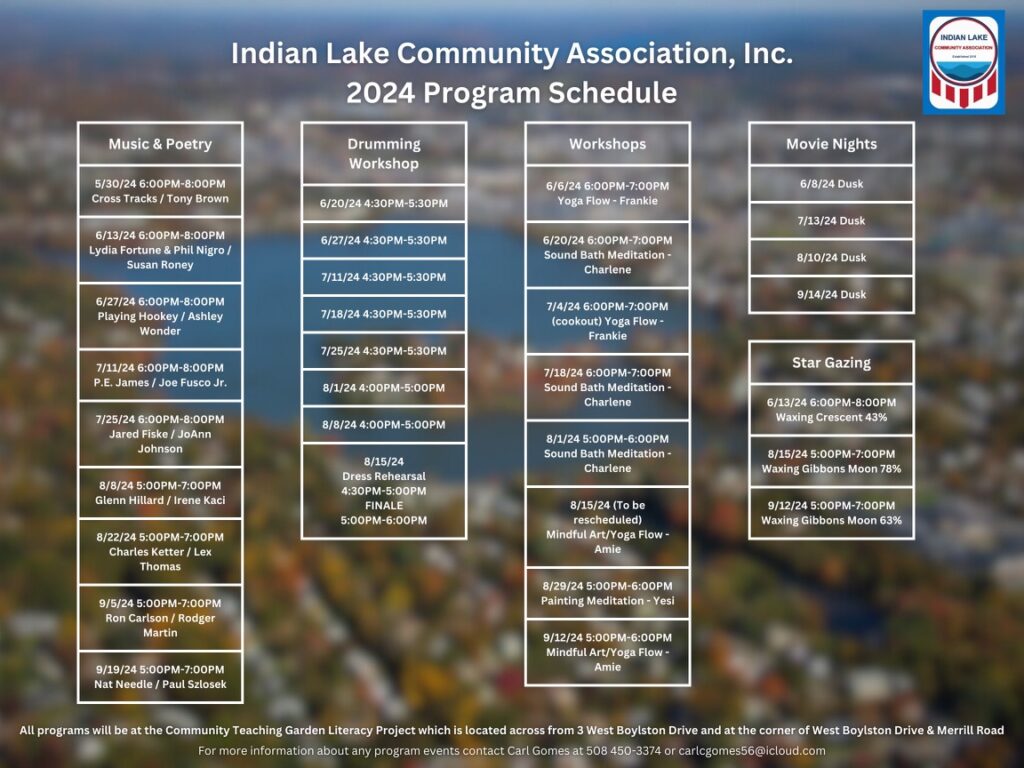
Indian Lake Community Association Summer Programs
Announcing the 2024 O’Hara Prize Winners!

Announcing the 2024 O’Hara Prize Results
1st Place: Paul Szlosek with “Neither In Nor Out“
2nd Place: Claire Schaeffer Duffy with “Off the Coast in Trapani“
3rd Place: Art DuBois with “Senses“
Honorable Mention: Matt Zingg with “Maturity“
A HUGE thank you to all of our wonderful participants! We got so many contributions and read some truly fantastic poems.
A big thank you to our judge Dennis Barone for his thoughtful consideration!
and a heartfelt Congratulations to our 2024 O’Hara Prize Winners!
We hope to see everyone at the O’Hara reading in September.
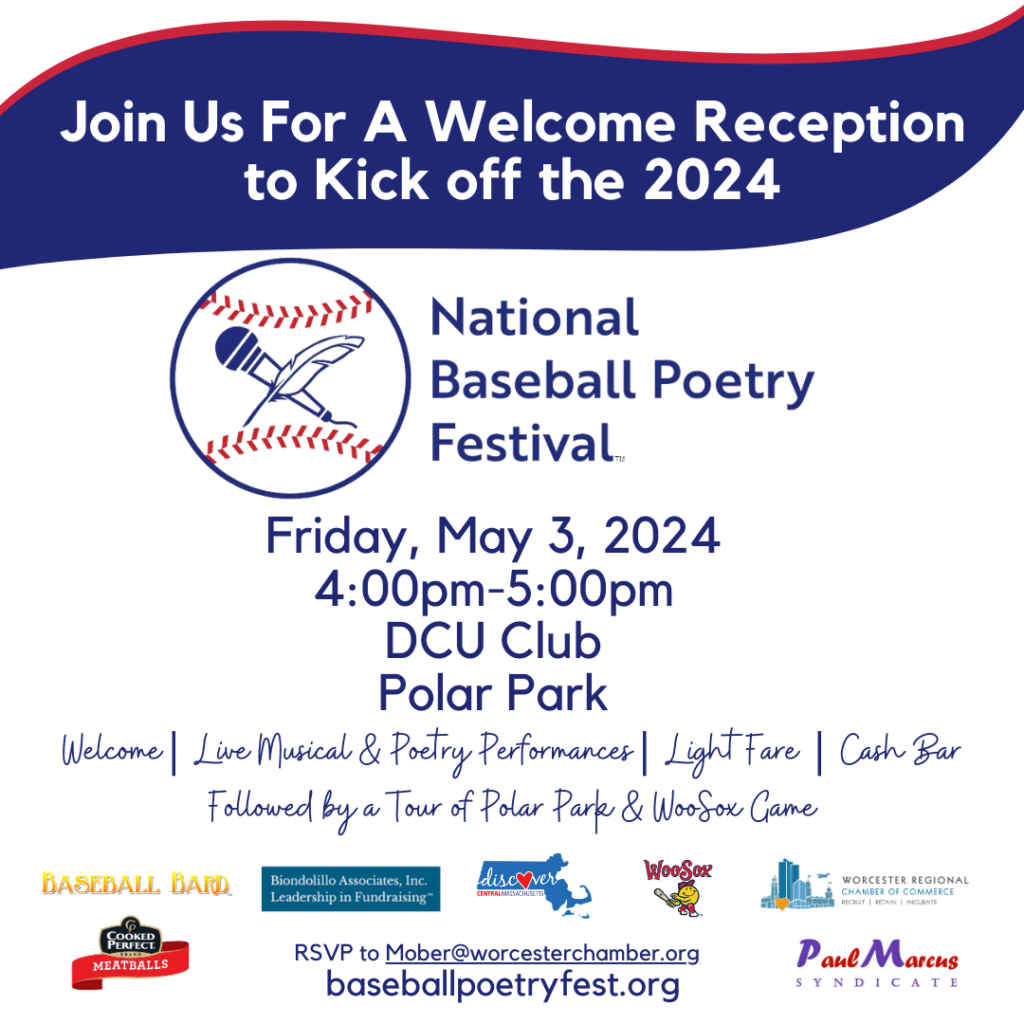
National Baseball Festival Welcome Reception
Rain Poets on the Radio!
Up next, another 33 and a 1/3rd Drop
The Drop offers a platform for sharing short segments of up to three minutes, 33 seconds or less on any secular and non-partisan topic of your choice. Your story, poem, or info tip can reach a wide audience. Drops are made available to on-air programmers to feature at their choosing. Join us in creating impactful mini-podcasts!
Why label these modules/mini-podcasts(?) “Up next, another 33 and a 3rd Drop?”
The title recognizes some key elements of playing recorded music from the not-so-distant past, the LP spinning at 33 and a 3rd, a 45 single coming in near 3 minutes 33 seconds and lastly, to play a LP you must “drop” the needle in the groove, “Up next, another 33 and a 3rd Drop” just works for setting the segment apart.
The Drops are made available to the programmer to use or not. They can be a helpful tool for the programmer who is trying to shift gears in a program. The shorter the segment, the more likely it’ll be featured. Each segment will be archived on WCUW with your accompanying info sheet that can be easily accessed by all on-air programmers.
Creators of Drops are encouraged to be members of WCUW and if needed, our studios are available for creating your Drops. Only secular and non-politically oriented Drops will be considered. The Drops must be FCC compliant.
The WCPA Online Bookstore is now live
The Worcester County Poetry Association now has its own bookstore!
The Worcester County Poetry Association has set up our own bookstore at bookshop.org. Many non-profits, organizations, and individual writers have taken advantage of bookshop.org, which allows organizations to create branded versions of their platform to highlight local authors and poets, and now we’re excited to do the same.
We’ve started with a few books from our board members and look forward to growing this collection, starting with our members. As a new perk for all WCPA members, we would love to list your books in our bookstore.
Current WCPA members: Please use the form below to send us a link to your book. We’ll be sure to include it in the bookstore and help promote it. To ensure
- The easiest way to list your book is to send us a link to the listing itself on bookshop.org. Go to their website, search for your book, and send us the link to that page.
- If your book is not listed on bookshop.org, that’s okay! Please send us the ISBN number for your book, and we can load your book on to our shop that way.
- I don’t have an ISBN! If you’re self-published and don’t have a listing on any websites or an ISBN, we likely won’t be able to help, but it doesn’t mean we can’t help promote your book in other ways. Please send us the title of your book and a link to your personal website or another source we can help promote, and we’ll see what we can do. We could also provide some instructions to help you obtain an ISBN if you would like, which may help promote your work elsewhere online.
Every purchase from our bookalso contributes a small amount to the WCPA, supporting our overall effort to promote poetry in Worcester County and our many programs.
If you’re not a member, please consider becoming a WCPA member today or purchasing one of the books from our new bookstore. We’d love to have you join us.
Elizabeth Bishop Graveside Reading: Valentines
At our annual birthday bash at Elizabeth Bishop’s grave in Hope Cemetery, local poets will read aloud her sardonic valentines and tender, poignant love poems, mostly unpublished during her lifetime. Readers include Elizabeth Bacon, Clair Degutis, Judith Ferrara, Claire Mowbray Golding, Kate Gregoire, John Hodgen, Irena Kaçi, Evan Plante, Eve Rifkah, Susan Rooney-O’Brien, Susan Elizabeth Sweeney — and Bishop herself! Refreshments will include birthday cake.
To get there, enter the cemetery’s main gate and continue on Curtis Avenue. Take your fourth left onto Beech Street (after Elm, Larch, and Bush), proceed for one block, and park. Bishop’s grave is behind the nearest tree on the left side of the road.
This event is sponsored by Mapping Worcester in Poetry. If you have any questions or wish to read a poem, please contact Kate or Beth. Until then, join us in pondering the “conundrum Love propounds” (Bishop, “Three Valentines”).
February 7th 10am
E.Bishop Grave at Hope Cemetery 119 Webster St.
Worcester, MA 01603
Walk In The Woo: 2023 Winners & Reading

PO Box 804, Worcester, MA
01613
worcestercountypoetry.org
wcpaboard@yahoo.com
508-797-4770
Announcing the WCPA Rain Poems: “A Walk in the Woo 2023”
The Worcester County Poetry Association is pleased to announce that the thirteen poems selected from their 2023 Call for Poems: “A Walk in the Woo” have been successfully painted around the city of Worcester. A team of volunteers and many of the poets themselves came together September 30th and October 1st, 2023 to prepare stencils and paint the poems around the city. A map of the poems’ locations and the poems themselves can be read at worcestercountypoetry.org/a-walk-in-the-woo/. Be sure to check out these poems whenever it rains and please save the date for our Rain Poems 2023 poetry reading open to the public on Sunday, February 26th at the JMAC PopUp at 20 Franklin St. from 2-4pm.
2023 Rain Poets, in no particular order
Evan Plante with “Staying Power”
Gertrude Malesi with “[Hatua za Wwenyeji]” (Swahili for “A gait that belongs”)
Jan Davini with “[The city beats in my heart]”
Aidan Brueckner with “Phantom Limb Syndrome”
Mark Wagner with “Flying Out of Worcester”
Laura DiCaronimo with “Hot Drops”
Chloe Mascitelli with “[The world feels lightest in Worcester]”
John Zywar with “Indian Lake”
Daniel Gregoire with “Worcester Time”
Lisa Knight with “Rain Magic”
Paul Szlosek with “[When Worcester was Worchester]”
David Ginsburg with “Forever Worcester”
Emily Haley with “History”
2023 Rain Poetry Honorable Mentions
John Zywar with “Interlude”
David Ginsburg with “Footsteps”
This years’ judges included Oliver de la Paz, Poet Laureate, City of Worcester; Vanessa Gonzalez-Oyola, Clemente Alumnus; Natalia Botero, Clark Student, and Katherine Gregoire, WCPA Board Member.
The poems were painted using Rainworks invisible spray, a paint that is only visible when wet. Keep an eye on the weather forecast and check out these poems when the rain begins to fall. The paint will begin to fade in a few months. This is the third year of the WCPA’s Rain Poetry Project.
About the Worcester County Poetry Association
The Worcester County Poetry Association (WCPA) was founded in 1971 with a threefold mission: celebrate the rich literary history and creative energy of Central Massachusetts through public readings, workshops, festivals, scholarly conferences, and other programs; support the publication of the literary journal, The Worcester Review; and collaborate with libraries, bookstores, colleges and universities, museums, churches, schools, community centers, businesses and a variety of cultural organizations to promote poetry events. The WCPA is an all-volunteer 501(c)(3) nonprofit.
Not for Publication:
For more information, contact Kate Gregoire, contest chairperson, katheanderson@gmail.com
Sponsored by:


